
Board feet lumber calculator
Board Foot Calculator
Accurately calculate lumber volume for your woodworking projects
Calculation Results
Board Feet = (Thickness (in) × Width (in) × Length (in)) ÷ 144
Common Board Examples
The first time I bought rough lumber, I made a costly mistake. I measured everything in linear feet, but the lumber yard priced the wood by board feet. Without using a Board Foot Calculator, I completely misjudged how much material I actually needed. I ended up buying far more maple than the project required, and most of it sat unused in my garage for nearly two years. That experience taught me how important it is to calculate board feet accurately before placing an order.
That’s when I decided to really understand what a board foot is and how to use a board foot calculator like the pros do. It turns out it’s not complicated. You have to think in volume instead of length. In this guide, I’ll walk you through exactly how to do that—whether you’re buying hardwood for furniture, plywood for a cabinet, or whole logs for milling. I’ll also cover those conversions that trip everyone up, like board feet to square feet and linear foot square foot calculator stuff. By the time you finish reading, you’ll be able to walk into any lumberyard and know exactly what to order.
So What Is a Board Foot, Really?
Let’s clear this up once and for all. A board foot is a measure of volume. It’s not about how long a board is; it’s about how much wood is in it. One board foot is exactly 144 cubic inches. That’s a piece that’s 12 inches long, 12 inches wide, and 1 inch thick.
Why do we use this instead of just measuring length? Because lumber comes in different thicknesses. A 2‑inch thick board has twice the wood of a 1‑inch thick board of the same width and length. If you priced by the linear foot, the thicker board would seem like a bargain, but the mill would go broke. So the industry settled on the board foot as the fair way to price everything.
When you see “bd ft” or “BF” on an invoice, that’s what they’re talking about.
Now, don’t confuse this with linear feet. That’s just length. If you’re buying baseboard trim, you care about linear feet. If you’re buying a slab of walnut for a tabletop, you care about board feet. And square foot is area—you use that for flooring, plywood, anything where thickness is secondary.
The Simple Formula You’ll Actually Use
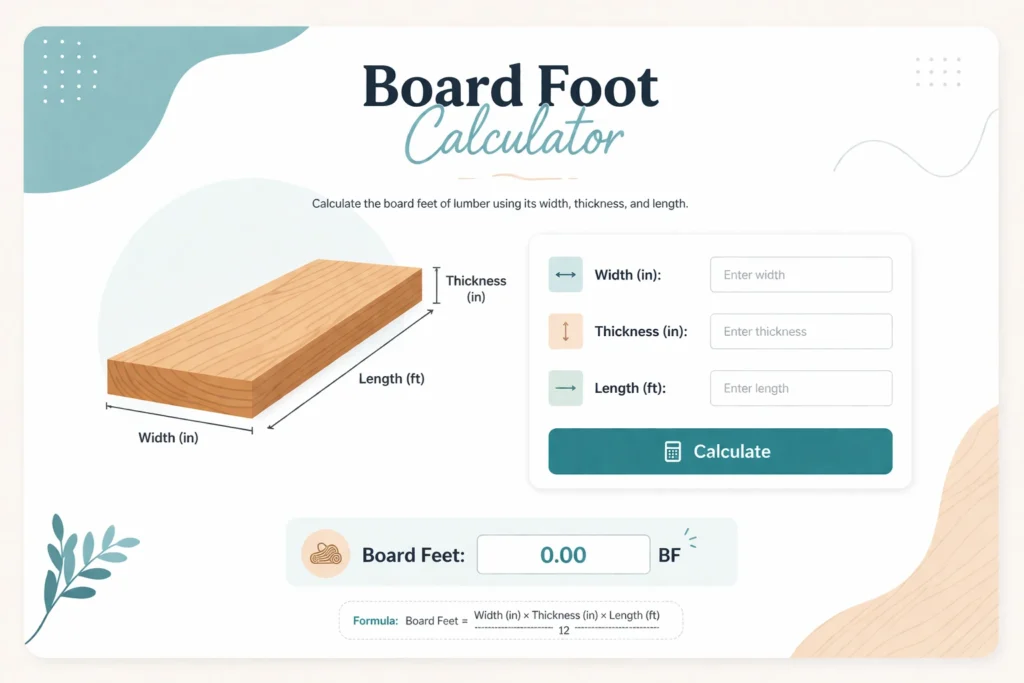
I’m terrible at memorizing formulas, but this one stuck because I use it all the time. To calculate board foot, you do:
Board Feet=Thickness (in)×Width (in)×Length (ft)12Board Feet=12Thickness (in)×Width (in)×Length (ft)
That’s it. Multiply thickness by width by length in feet, then divide by 12.
If someone hands you a board and the length is in inches, use:
Board Feet=Thickness (in)×Width (in)×Length (in)144Board Feet=144Thickness (in)×Width (in)×Length (in)
Let me give you a real example. A couple of months ago, I was building a desk with 8/4 hard maple. “8/4” means 2 inches thick. I picked a board that was 8 inches wide and 9 feet long. So I did: 2×8×9=1442×8×9=144, divided by 12 = 12 board feet. That was easy enough to do in my head, so I knew exactly what I was paying for when the guy at the counter rang it up.
For softwood like 2x4s, there’s a little twist. The lumber industry uses the nominal dimensions—so a 2×4 is treated as 2 inches by 4 inches even though it’s actually 1.5″ x 3.5″. So a 2×4 that’s 8 feet long is 2×4×8=642×4×8=64 ÷ 12 = 5.33 board feet. That’s what they’ll charge you for.
When You’re Dealing with Plywood
Plywood is different because it comes in sheets, not random lengths. But sometimes you need to think in board feet to compare prices or to mix solid wood and plywood in the same estimate. That’s where a ply board calculator approach comes in.
A standard 4×8 sheet of plywood is 4 feet wide, 8 feet long, and let’s say ¾ inch thick. To find the board footage, you convert everything to inches: 0.75×48×96=34560.75×48×96=3456 cubic inches. Divide by 144, and you get 24 board feet per sheet. If you’re buying ½‑inch plywood, it’s 16 board feet per sheet. That’s useful if you’re trying to compare the cost of solid wood vs. plywood for something like cabinet sides.
But most of the time when you calculate plywood, you’re really trying to figure out how many sheets to buy. Say you’re putting a new floor in a camper van. The floor area is 5 feet wide by 10 feet long—50 square feet. A 4×8 sheet is 32 square feet. So 50 ÷ 32 = 1.56 sheets. You can’t buy 1.56 sheets, so you buy 2. And because you’ll have cutouts for wheel wells, you might even buy 3 to be safe. I always add a waste factor. For simple rectangles, 10% is fine. For complex shapes, I add 20%.
The Linear Foot–Square Foot–Board Foot Confusion
I can’t tell you how many times someone has asked me to convert board feet to square feet or the other way around. It’s actually easy if you remember that thickness is the bridge.
If you have a square footage and you want board feet, use:
Board Feet=Square Feet×Thickness (in)12Board Feet=Square Feet×12Thickness (in)
For example, my buddy was installing ¾‑inch oak flooring in a 20×15 room. That’s 300 square feet. 300×0.75=225300×0.75=225 board feet. He added 10% for waste and ended up with 248 board feet. That’s exactly what he ordered, and it worked out perfectly.
If you have board feet and you want square feet (like if you’re trying to figure out how much surface area you can cover), flip it:
Square Feet=Board Feet×12Thickness (in)Square Feet=Thickness (in)Board Feet×12
So if you’ve got 500 board feet of 4/4 (1‑inch) cherry, you can cover 500×12=6000500×12=6000 square feet of surface area. That’s useful for veneer or paneling.
Now, a linear foot square foot calculator is handy when you know the width. If you have 100 linear feet of 6‑inch‑wide boards, that’s 100×0.5=50100×0.5=50 square feet. And if you’re dealing with dimensions like 12 ft 6 inches by 8 ft 3 inches, a square foot calculator with inches does the conversion for you, so you don’t have to do fractions. I use one on my phone whenever I’m estimating flooring.
Logs: Where Things Get Real
Calculating board feet of a log is a whole different animal. A log is round, it has bark, it tapers, and it might have hidden rot or knots. You can’t just measure it like a board. Sawmills use something called log scales—basically formulas or tables that estimate how much lumber you’ll actually get out of a log after it’s cut.
There are three scales you’ll hear about: Doyle, Scribner, and International 1/4‑Inch.
- Doyle is popular in the eastern U.S. The formula is (D–4)2×(L/16)(D–4)2×(L/16), where D is the diameter inside bark at the small end (in inches), and L is the length in feet. For a 10‑foot log with a 12‑inch diameter, Doyle gives (8)2×(10/16)=64×0.625=40(8)2×(10/16)=64×0.625=40 board feet.
- International 1/4‑Inch is more accurate overall. The same log might give you 55–60 board feet.
- Scribner is common in the West, often presented in tables.
If you’re buying logs, ask the seller which scale they use. A log board foot calculator can switch between them, so you know what you’re getting. I learned an important lesson when I bought some white oak logs.
Real‑World Examples from My Own Projects
Let me walk you through how I used these calculations on actual builds.
A Dining Table
I built a dining table from 8/4 walnut. The top was 38 inches wide and 72 inches long (6 ft). Thickness 2″, width 38″, length 6 ft → 2×38×6=4562×38×6=456 ÷ 12 = 38 BF. The legs were 8/4, each 3″ square and 30″ tall (2.5 ft). One leg: 2×3×2.5=152×3×2.5=15 ÷ 12 = 1.25 BF. Four legs = 5 BF. The aprons were 4/4 (1″ thick), 4″ wide, and 20 linear ft total. 1×4×20=801×4×20=80 ÷ 12 = 6.67 BF. Total = 49.67 BF. I added 15% for waste and grain matching, so I ordered 57 BF. It came out almost exactly right.
A Shed Floor
I helped a neighbor with a shed floor. The area was 12 ft × 16 ft = 192 sq ft. We used ¾″ plywood. Number of sheets: 192 ÷ 32 = 6 sheets exactly. But we added one more for waste because the floor had a few cutouts for posts. So we bought 7 sheets. If I had needed to express it in board feet for some reason, it would be 7 sheets × 24 BF per sheet = 168 BF.
Buying Oak Logs
A local sawyer had some red oak logs. One log was 12 ft long, 15 inches in diameter inside bark. I used a log board foot calculator on my phone to compare scales. Doyle gave me about 90 BF, and International gave 110 BF. The sawyer was using Doyle, so we agreed on a price based on that. I knew going in that my yield would be lower, so I didn’t feel cheated.
Questions I Get Asked All the Time
How to calculate board feet?
Multiply thickness (in) × width (in) × length (ft), then divide by 12. Or use an online board foot calculator if you want to double‑check.
What is a board foot?
It’s a volume of 144 cubic inches—a piece 12″ × 12″ × 1″.
How to calculate board foot measure?
Same as above. “Board foot measure” is just the term lumberyards use for that calculation.
How to figure linear feet?
Measure the length in feet. A 12‑foot board is 12 linear feet. Width and thickness don’t matter.
How do you figure linear ft?
The same. It’s just the length.
How to figure out board feet?
Use the formula. If you have a bunch of different sizes, a bf calculator or a board footage calculator can sum them up quickly.
How tall is 50 OSB sheets 7/16 x 50?
“7/16” is the thickness. If “50” means 50 sheets of standard 4×8 OSB, then stack height = 0.4375×50=21.8750.4375×50=21.875 inches, about 22 inches. If “50” is the length in inches, the sheets are non‑standard, but the math is the same: thickness times number of sheets.
A Few Things I’ve Learned the Hard Way
After years of buying lumber, I’ve picked up some habits that save me money and frustration.
- Always add a waste factor. I do 10% for straight cuts, 15–20% if there’s grain matching or angles.
- Write everything down. When I’m estimating, I keep a notebook with dimensions and board foot totals. It’s easy to forget a number when you’re standing at the lumber rack.
- Don’t trust nominal dimensions. A 2×4 isn’t 2×4. For board foot calculations, use the nominal, but when you’re designing, use the actual.
- Ask about the log scale. If you’re buying logs, don’t assume the seller uses the same scale you do. Clarify first.
- Use a lumber calculator for big projects. There are free ones online where you can input all your pieces and get a total board feet. It saves a lot of time.
Why This Matters Beyond the Math
Knowing how to use a board foot calculator isn’t just about getting the numbers right. It’s about having confidence when you walk into a supplier. It’s about not getting ripped off because you don’t know how to verify a quote. And it’s about respecting the material—wood is expensive, and wasting it feels bad.
When I first started, I’d guess. Sometimes I’d guess too high and have leftover lumber that sat for years. Sometimes I had guessed too low and had to make an extra trip to the lumberyard, which always costs more time than the wood itself. Now I calculate first, then I buy. It takes a few minutes and saves me hours and dollars.
Wrapping It Up
So, that’s really all there is to it. A board foot isn’t magic. To accurately estimation the volume of wood, multiply its length, width and thickness. It is a basic calculation that ensures precise measurements for your project, then dividing by twelve. I still make mistakes with it sometimes when I’m in a rush. For example, last month, I purchased forty board feet of cherry when I only needed twenty-five, and I felt foolish walking back to return the excess.
To avoid issues, keep a calculator on your phone, double-check your numbers, and always buy a little extra to account for mistakes. You’ll be fine! Now, go ahead and measure your wood.